Showing posts with label Interview. Show all posts

Saturday, October 20, 2012

James the Vampire


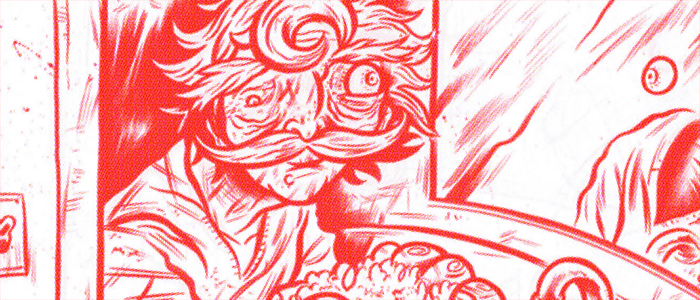
Nikolaus Janos Khoulasci AKA James the Vampire, made a name for himself as a member of the Lenin Boys, enforcing in the name of Hungary's brief Soviet Republic.  He was executed in reprisal for his crimes during the Hungarian White Terror of 1921.  Since his death he has dedicated himself to art, being relieved of morality.
Follow James the Vampire here: jamesthevampire.blogspot.com

What inspired “Disappeared Volunteer”? Have you done any volunteer work? Is this story autobiographical?

My work is never autobiographical. Nothing is less interesting to me than our mundane lives. But, the situation of politics in the particular is a definite interest throughout my work.

What are some of your favorite horror stories? (And they don’t have to be limited to comic books.)

Picking particular works is difficult.  I see horror as consisting in two areas, the unknown, and moral transgression. To that end, I would probably pick something by David Lynch, either Mulholland Drive or Inland Empire.

Who are some of your comic book influences?

Hernandez Bros, George Gross, Hirohiko Araki, Suehiro Maruo, CLAMP

Explain to Hellbound readers your creative process. Was the story written independently and before the art or did both develop together?

My creative process is not divided into planning/executing. Sometimes I will have a complete vision and notes to work from ahead of time. Usually, though, I begin from a general idea, or ideas, and let the work develop on its own. I never write scripts. I never do concept sketches. Creation and production are one and the same for me.

What did you find most challenging about this story?

Maintaining the balance between ambiguity (the unknown is the real realm of the terrifying) and coherence, or readability. 

Artistically, was there anything you were hoping to achieve?

Yes, I was hoping to achieve a more consistent look in terms of the visuals, and in many ways, I met that goal.

Are you happy with the results?
Very.

Thank you, James.

Thursday, October 18, 2012

Joshua D. Hoaglund


Joshua D. Hoaglund is a Staff Animator at Rockstar Games where he has worked on Max Payne 3 and Red Dead Redemption. In addition to his position at Rockstar, Joshua has taught the course, Introduction to 3-D Modeling and Animation, at Harvard University Extension School in Cambridge, Massachusetts. Joshua is also working on a graphic novel. His other interests include glass, sculpture, illustration, and painting. He spends his spare time with his 5 year old daughter Mayari, wife Rise Riyo, and family cat Chowder.

More of Joshua’s work can be found here: http://joshuadhoaglund.blogspot.com/  http://joshua-hoaglund.com/index.html

What inspired “Vengeance”?

The inspirational elements of this story came together when I was on vacation in Vancouver. I was with my 4 year old daughter, Mayari, on a whale watch. The whale watch was the kind where the advertisements guarantee that you will see whales, yet there were no orcas to be seen during our trip. Since we were still excited to see whales, we returned for a complimentary second attempt. As I sat on the shuttle bus on the way to the boat, these images and story line came into my mind. “Vengeance” brings together memories of my childhood and fables from North American Mythology.  The whaling part of the story comes from my childhood growing up in New Bedford, MA where whaling fishery/industry was the main source of income from 1800s. My hometown provided the background for a setting where whales were being harvested. I was also inspired by Native American stories such as The Lord of the Undersea and his wife Talia. The tale is about how the Lord of the Undersea disguised himself as a whale and seduced a woman named Talia away from her family and made Talia his wife.

This is your second story in Hellbound, are you fan of horror?

Yes, I love horror. I am an uncloseted horror fan. I march in horror pride parades on Halloween. In all seriousness, despite being a horror fan, I did not search out the genre. The stories I have done for Hellbound have suited the horror genre pretty well without my ever setting out to tell horror tales. I am glad that there is a venue like Hellbound for stories like mine.

If so, what are some of your favorite horror stories?

I love supernatural stories and stories that involve magick, occult, otherworldly places, and fables. I prefer fables that are not watered down for modern children. I enjoy tales that have macabre elements, like murder and disembowelment. I also like TV series with stories similar to the Twilight Zone, Walking Dead, Discovery Channel‘s Ghosthunters, and A&E’s Hauntings. Some of my favorite authors are Neil Gaiman, Mike Mignola, J. K. Rowling, and Anne Rice.

Explain to Hellbound readers your creative process. Was the story written independently and before the art or did both develop together?

I gestate the story in my mind before I start making drawings. If the idea does not stick around for a while, I forget about it unless it develops. Then I crudely draw it, to get the tale down on paper. I start to tell the story using drawings, symbols and words. I don’t start with thumbnails all the time. Sometimes I just draw directly with a pen in a notebook. Then I scan in my inked drawings into the computer. I lay out the story using a scanner and a computer. The scans are organized in whatever format the final print will be. On the computer I can change my story layout easily. When there are ideas I need to express quickly, I will switch to writing words on the drawing boards or on the layout pages on the computer.  I print out copies of my story and make many rough drafts onto which I edit directly. The printed rough drafts really help me get a sense of how story will translate to print. When drawings do not look right, I edit by redrawing them entirely or using tracing paper to keep only the best parts. I rework panels, add new panels, scan them into the computer then print out another draft to proofread.

What prompted you create a wordless story?

I wanted to write a story that can be read by anyone who speaks any language. For a wordless comic the reader can focus purely on the language of the drawing.

What did you find most challenging about “Vengeance”?

The biggest challenge for “Vengeance” was completing this story. I was moving across country to California when “Vengeance” was due. The deadline for Hellbound III was literally at the same time I was starting my new job at Rockstar San Diego. I really wanted to complete the story, so, I was drawing the pages in hotel rooms at night during the cross-country trip. When we arrived in California, I had a little time before our belongings were delivered to our condo. That was the time I finished inking the last pages. I thought I was finished after that first draft of “Vengeance” was submitted. However, at that stage, being a wordless comic, and a first draft, “Vengeance” was still unclear. The Hellbound editing team and my wife, Rise Riyo, pointed out the areas that were unclear. After a discussion with the Hellbound story editor Jerel Dye, we decided to continue working and refining the story. With additional editing from Rise Riyo, I finalized details and redrew many of the panels, for the second draft. Together we edited 75% of the last three pages of “Vengeance” for the second draft to be complete.

Artistically, was there anything you were hoping to achieve?

I had three goals when I wrote “Vengeance.” I wanted to make a story that surprises the reader. I wanted a tale that expressed rage and anguish about environmental exploitation. I wanted the drawings to be pretty raw like punk rock music. I was thinking about the sounds of the story a lot. If the ideas for the story were music, that music would sound like a fusion of Environmental background music with Death Metal. The punk look I wanted to achieve would have a block cut and rough pen stroke quality.

Are you happy with the results?

I am happy that all the people who have read the story get a bit of a surprise when they get to the end. I feel that it went through a difficult final stage. I feel that going through that made a better story in the end. I am still both pleased and critical of the artwork.

How does that feel to be one of a few creators who have had a story published in multiple issues of Hellbound?

I am very honored to be in Hellbound a second time and am very grateful to the Hellbound crew.

I realize a theme has yet to be decided but have you begun working on your Hellbound IV story?

I have been working on a graphic novel based on a character from a dream. The graphic novel is similar to a “fun book” with mazes and games related to the story. The mazes are on the same pages as the story so they are related. The story includes zombies and monsters; some vampires too. The story is about a skateboarder who becomes a thief for a daemon. Then reader follows the skateboarder as he delves deeper into an underworld of monsters. I am not sure if it will match any upcoming themes for Hellbound IV. If not, I do have other work that may be a fit for Hellbound IV.

Thank you, Joshua.

Saturday, September 29, 2012

Stephen Cartisano and Ellen T. Crenshaw


Stephen Cartisano a member of the Boston Comics Roundtable and a sometime writer. 

Ellen T. Crenshaw is a Boston-based freelance artist, movie-goer, comic-book-reader, and dirty-joke-teller. Her comics have been featured in Inbound, ZombieBomb!, and the critically and publicly acclaimed Womanthology. She's an alumni of Girls Drawin' Girls, a member of the Boston Comics Roundtable, and co-founder of the fan-art blog, Fanartica (fanartica.tumblr.com).

For more information and pretty pictures, visit www.etcillustration.com!

What inspired “America’s Pastime”?

Stephen: A couple of things; first, I wanted to play around with the idea that one person’s deviance is another person’s norm. Second, failed past attempts getting published in previous anthologies. I was trying to avoid mistakes I made earlier. 

Is this your first horror story?

Stephen: Yes, to first story published but no, to first horror script written. Last year, I wrote an eight page tale but I lost track of time and before I realized it, the final deadline was fast approaching. I tried to find an artist but wasn’t able to do so. I planned on using that story this year but I didn’t think it was dark enough so I wrote a new one from scratch. I hope the first script fits the theme of Hellbound IV because I’m proud of it and I would like to see it illustrated.

Ellen: Yes. Horror doesn't really fall into my comics repertoire, but there was something about Steve's script that spoke to me—it's horrible, but cheeky and darkly funny—and I thought my drawing style could lend itself well to the charming relationship between our murderer and his lady.

Are you a fan of horror? If so, what are some of your favorite stories? (And they don’t have to be limited to comic books.)

Stephen: Yes, but I’m not fanatical about it. I grew up with the birth of cable. Our first cable remote had a cord running to the cable box. Don’t laugh; it made it impossible to lose. I remember the night I was alone and watched Friday the 13th for the first time. When it was over, my parents couldn’t return home fast enough. I also watched The Howling and My Bloody Valentine (the original) more times that I can remember. Also, I use to record episodes of Tales of the Crypt religiously. They’re currently gathering dust in a storage locker with my comic book collection. Current favorites include Dawn of the Dead (the original) Near Dark, Let the Right One In, and The Crazies (the remake). As for books, I read Stephen King and Clive Barker when both were in their prime. I seldom read horror now but when I get the itch, I’ll pickup The Stand or The Thief of Always (one of my favorite titles).

Ellen: I get scared too easily to be a horror-buff. When I was a kid, I read my mom's copy of Creepshow and couldn't sleep! Even now, Stephen Gammell's illustrations in Scary Stories to Tell in the Dark make me want to look over my shoulder for monsters.

Explain to Hellbound readers your creative process. Was the story written independently and before the art or did both develop together?

Stephen: My first publishing job was at Warp Graphics, the publishers of ElfQuest. I was a production assistant and interacted with the artists and writers regularly. Not understanding the comic creating process, I assumed the writer was the “lead singer” and the artist was the “backing band.” I quickly learned that was incorrect. It's was very much a partnership. If the writer fails to engage the artist, the art will be uninspired, late, or both. Since I’m not an artist and I was working independently of one, I did my best to visualize the story but tried to write the script in such a manner that an artist wouldn’t find restrictive. Shortly after I joined the Boston Comics Roundtable, I wrote a script for a different anthology that was drawn by a fellow BCR member. I wanted him to have free reign over the art. One, he self published regularly so he clearly knew more about art that I did and two, his vision of the story was excellent. I was very happy with the result. I feel the same about Ellen and “America’s Pastime.” It was better than I could hope for!

Ellen: D'aw—thanks, Steve! This collaboration marks only the second time I've illustrated comics for another writer (the first time was with my husband, Matt Boehm, for Inbound 4), but I think I approached this project the same way I would had I penned the story. I know many comic artists can't separate words and images when developing a plot, but when a concept requires dialogue I almost always write a script first. I ruminate over the script; play out the action in my head to get an idea of how best to visualize it. I plan out the pages, laying down panels first to get a sense of the overall design, the big picture. I sketch out the characters and keep them close-by. I gather a lot of visual reference, and then I just start drawing. When I get stuck, I'll act out scenes and take lots of ridiculous pics in Photobooth.

What did you find most challenging about “America’s Pastime”?

Stephen: The four page limitation was tough. I didn’t want to overwhelm the artist with too many panels. Originally, the main character was going to be experiencing a crisis of faith in his mission and his partner was going to comfort him. I wanted to end the story on an especially dark joke. When I was writing it, I realized there was too much of an emotional shift keeping every thing I mentioned earlier. I decided to change the core of story to what it is now because I felt it worked best with the dark joke ending. When I submitted the script for Jerel’s review, he recommended removing the joke ending because it seemed heavy handed and sort of cheapened story. Even now, months after the feedback, I can’t say I agree but by removing the ending and the panels that lead up to it, I reduced the panels per page which I thought would allow the artist more freedom to work their magic.

Ellen: Character design is one of my strong-suits, but oddly enough one of the hardest things was designing Grandslam. I wanted to stay true to Steve's vision (and he provided excellent references), but I still had trouble wrapping my head around his costume. I guess I tried solving that problem by throwing spikes all over everything!

Did you experiment with this story?

Stephen: For me, writing is an experiment in itself. It doesn’t come natural which is one of the reasons I like doing it.

Ellen: Being that horror is an uncommon genre for me, I took the opportunity to employ some techniques I don't otherwise get to use—high-contrast shadows, extreme vantage points, swaths of black ink washes.

Artistically, was there anything you were hoping to achieve?

Stephen: I wanted to keep the story short. I was concerned if it was long, it might work against it being accepted. Also, setting a limitation challenges me creatively; sometimes I get intimated without parameters. As I get older, I find the truth in the saying ‘less is more’ in many different aspects of my life. That includes writing.

Ellen: I was hoping to shine light on the campiness and dark humor of the piece with my cartoony drawing style. I feel that if it were drawn with more realism, the story would be equally good but have an entirely different tone. I wanted to draw out (no pun intended) the aspects of the story that enticed me to work with it—it's disturbing, but there's something sweet about it, and Stephen has nearly made us root for Grandslam by indeed making the teenagers contemptible. (As a nerdy artist, it's all too easy to shun the jock and the cheerleader!)

Where you happy with the results?

Stephen: Yes, very.

Ellen: Yes!

Thank you, Stephen and Ellen.

Thursday, September 27, 2012

Kimball Anderson


Kimball Anderson does comics that sometimes have poetry in them and sometimes have experimentation in them. But never are these tools used just to use tools. The intent is always an earnest interest in communicating ideas and feelings as best as they can be communicated.

More of Kimball's work can found here: earnestattempts.tumblr.com

What inspired “No, He Can Come”? Is it autobiographical?

It is not autobiographical! It was inspired by conversations in the dark, where you are trying to grasp at what is on the face of the person you are talking to, but all you really see are shifting shapes and static. You don't know the person's emotions, but it almost seems like you could, so maybe you try...and you see monster faces, or emotions that just aren't accurate.

Is this your first horror story?

This is my second horror story! I made a story for last year's Hellbound but was maybe too ambitious with it, and it didn't get in. This time I tried to remember that simple is good for horror.

Are you a fan of horror? If so, what are some of your favorite stories? (And they don’t have to be limited to comic books.)

I like some horror, but I guess I generally do not seek it out. I remember the old "Ted's Caving Page" fondly. I think horror is very much helped by the slight possibility that it is true, and the internet is a good way to do that. That said, I am not too interested in other "creepypasta", but sometimes an Alternate Reality Game will have an effective bit of horror in it. Junji Ito can be pretty good, too. And, though I wouldn't label them as my favorites, I enjoy lots of television shows with horror elements! Like The Vampire Diaries and Teen Wolf. They have obvious flaws, but the way they are structured and produced is interesting, when viewed in the wider context of television structuring.

Explain to Hellbound readers your creative process. Was the story written independently and before the art or did both develop together?

I came up with the art style first, as a way to evoke night. I wrote a script for this style, which was not horror themed, but played on many of the same emotions as my Hellbound story. And when the theme for Hellbound 3 was decided, I immediately knew that the style I had previously conceived of would work for the anthology. So I came up with a new story, and started drawing! I drew pencil shaded figures on white paper, scanned, and put it on a digital black, which was then given a static-y texture.

What did you find most challenging about “No, He Can Come”?

The comic flowed more naturally out than some do, in terms of art. But in terms of story, I had a lot of trouble coming up with something that felt meaningful and was simple. Because I hadn't originally conceived of it as horror, it was hard to change gears, mentally.

Did you experiment with this story?

I experimented in terms of art style, as I had never done anything that looked like this comic before. And in more subtle ways I experimented in writing. Most of my stories are very deliberately about themes and ideas, and with this I went at it in a very straightforward way. I think short form horror necessitates this. You have to attempt to play the beats of a horror story, and you don't have much space for anything else. You just have to tell the story.

Artistically, was there anything you were hoping to achieve? Where you happy with the results?

While I wasn't trying to communicate any themes or ideas, I was trying to evoke what it feels like to be in that place. I was trying to be very authentic to the sensation of the dark and to the emotions of the characters. My aim was to create a feeling that is taken as familiar and true.

Thank you, Kimball.

Tuesday, September 25, 2012

Lindsay Moore, Donna Martinez, and Joey Peters


Lindsay Moore is a long-time fan of the horror genre. This is her sixth published comic. When she isn't writing scary stories, she enjoys long walks on the beach, watching scary movies, and dreaming up new ways to terrify people. She is currently writing a superhero comic that will debut in March, 2013.

Lindsay also decoupages boxes with comic book and cartoon characters. They can be purchased here: etsy.com/shop/boxybrown

Donna Martinez is a cartoonist and artist originally from Gallup, New Mexico.

See more of Donna’s art here: donnamartinez.net

Joey Peters is a writer, cartoonist, and beauty contest champion from Boston.

More of his work can be found here: superwizard.net. Buy some of it!

What inspired “Garbage”?

Lindsay: There were two things that inspired "Garbage." One of them was Amy Chua's book, Battle Hymn of the Tiger Mother, a memoir about raising her two daughters. In it, she's very open and unapologetic about her methods; she browbeats these two little girls, forces them to practice piano for hours on end, and calls them "garbage" when they displease her. For me, the fact that she would just call her own kids "garbage" really stuck out. Garbage is a gross, inanimate thing that you hate and want to get rid of; calling a person "garbage" is tantamount to telling them that they repulse you and that you want to get rid of them. For me, that seemed far worse than anything else she admitted to doing. Shortly after this book came out, there was a huge uproar, and an older article about a girl named Esmie Tseng resurfaced. Esmie Tseng had a domineering mother who would routinely force her to practice piano for hours on end and would punish her for minor things like getting an A- on a test by making her stand naked in a corner. In 2005, Esmie Tseng snapped and stabbed her mother to death. The intense pressure and constant criticism had just destroyed her; to her, there was no other way to escape. "Garbage" is very much inspired by that, but it's not told from the point of view of the killer or the victim; it's told from the point of view of an outsider watching this event unfold who is powerless to stop it.

Donna: For me I’ve worked with Lindsay on other stories and she’s been really great to work with. Because of that, when I read the story, I knew I’d want to draw for her again.

Are all of you fans of horror? If so, what are some of your favorite stories? (And they don’t have to be limited to comic books.)

Lindsay: I am a huge fan of the horror genre. As I kid, I practically devoured R.L. Stine's Goosebumps series, and those launched me straight into Stephen King territory. I think my all-time favorite horror stories come from the TV show, Tales from the Crypt. The show often revolved around bad people getting what they deserved, and I really latched onto that as a teenager. There was something about karma always catching up to you that really excited and terrified me, like it was this unstoppable force that you just couldn't outrun.

Donna: Even though I myself am fascinated by real-life macabre places and things and also with the occult, horror movies are still too scary for me. That’s probably because my mom watched a lot of horror films when I was young and I just got too freaked out by it all. It’s silly I know, but give me a crypt full of mummies or a traveling sideshow of freaky natural phenomena over a Friday the 13th film any day!

Explain to Hellbound readers the creative process. Was the story written independently and before the art or did both develop together?

Lindsay: The script/story came before the art. I wrote "Garbage" and then asked Donna if she wanted to illustrate it. She illustrated another script for me a while back, and I've always loved her art style.

Donna: Lindsay wrote the story first, I then did character sketches for the two girls, followed by thumbnails of the story itself. I showed both to Lindsay and she gave me whatever feedback I needed to solidify things. Doris was the first I came up with and she didn’t change at all from the initial sketch. I drew a teenage blond girl with a neat, preppy look to her and that was pretty much it. With Brenda I tried out different punky hairdos, different types of piercings and clothing. I knew I wanted to go for a later 70’s ska/punk kind of look rather than something obvious like a giant Mohawk or anything plaid. I didn’t want her to look like a mall punk; I wanted her to have her own thing going.

What did each of you find most challenging about this story?

Lindsay: For me, it was writing from Brenda's point of view instead of Doris's. We miss out on a lot of details when we see the story from Brenda's point of view because she's an outsider, she doesn't know the full extent of Doris's situation or what has led her to this point. I wanted to tell the story from Brenda's point of view because she's the character we can relate to. She's an average girl who's just trying to figure out what is going on and do the right thing. I think that Donna's art helps tell the story and fill in the details; she's added a lot of small things, like musical notes on Doris's notebook, that tip the reader off as to what's going on.

Donna: The challenge for me was to make sure I could convey in the art the sense of tension, fear, and horror at the very end. Right up until Brenda gets to the house, the story could be just another teen drama. Then you find out what’s going on in the house and it turns everything upside down.

On page six when Doris and her actions are revealed, I wanted her to look very calm, as though she wasn’t really doing anything wrong. That she was just dealing with a problem, albeit by murdering her own mother. There’s a classic scene in the Sandman story ‘A Game of You’ where the witch Thessaly is peeling the face off a dead man. She’s being very exact about it because if she’s not, her spell might not work. Neil Gaiman and artist Colleen Doran decided that the more calm and steady Thessaly appeared in doing such gruesome work, the scarier it would be. And it does work really well so that was definitely my aim. It’s really in the last panel of that page that there’s the tiniest break in her calm demeanor as she goes to finish the job.

Donna, artistically, was there anything you were hoping to achieve?

Donna: With any project I do, my aim is to give the writer what they’re asking for. Lindsay can probably tell you that I more or less achieved that. Again, I just wanted to build up to the main action of the story and make it as tense as possible so that when the big reveal happens, the audience is just knocked over by what they’re seeing. The theme for this Hellbound is darkness so I really wanted to drive home the internal darkness that existed in Doris despite her neat appearance and shy demeanor. Once the book is in the hands of the readers I’ll find out for sure whether or not I succeeded!

Where you happy with the results?

Lindsay: I am thrilled with the result. I can't thank Donna and Joey enough for their hard work.

Donna: I think so. There are a few things I’d do over again but there are also some fantastic facial expressions that I’m very proud of. Also, Lindsay seems pretty pleased and that means a lot to me.

Lindsay, how does it feel to be the only creator to have a story published in each of the three Hellbound comics?

Lindsay: Honestly, it feels a little weird. I didn't realize that I was the only recurring creator until you pointed it out. I'm just excited to be a part of Hellbound, and I appreciate Roho and the rest of the editorial staff for giving me a creative outlet.

Have you begun working on your story for Hellbound IV?

Lindsay: I've got a bunch of ideas floating around. I'm in the process of fleshing them out.

Donna: Not yet, but if I start now I think I can be on time with this one!

Thank you, Lindsay and Donna.

Monday, September 24, 2012

Adrian Rodriguez


Adrian Rodriguez credits his early interest in art to his fascination with Halloween and super hero comic books, though he admits his exposure to the comic medium was largely relegated to a small novelty store in the neighboring town that carried used/uninspired knock-offs of mainstream mags. After an extended undergraduate career and much debt, Adrian received a both a BFA and a Diploma Certificate from the School of the Museum of Fine Arts, Boston, where he studied printmaking and drawing.

H. P. Lovecraft - characters on the brink of insanity at all times. “I went mad then…”

What inspired “Pedestrian”?

A lot of my work has to do with perception.  In “Pedestrian”, I wanted to challenge the reader’s perception of the events as they unfolded as well as the main characters’ psyche. Is he being pursued or is it imagined? Do we as readers assume he is a victim of some type of persecution or is he guilty of some crime and has a valid cause for anxiety? Plus, the easiest and most fun type of story: create a character and then torture him.

I take it from your fascination with Halloween that this probably isn’t your first horror story, correct?

All of my work is horror or absurd.

What are some of your favorite horror stories? (And they don’t have to be limited to comic books.)

Frankenstein is top. Lovecraft, of course. I love how the characters in Lovecraft’s stories are always teetering on the edge of insanity; the slightest thing pushes them over the abyss. The Scary Stories to Tell in the Dark series. I had the Marvel “What if Wolverine was Lord of the Vampires?” comic that was insane. Everything Jack Davis and Johnny Craig did for EC. And I read the pre-code horror blog The Horrors of It All religiously. Richard Scala is great too. 

Explain to Hellbound readers your creative process. Was the story written independently and before the art or did both develop together?

It’s a chaotic mess. I typically start with a notion and let it develop on its own—both in story/content and visually. What’s worse is I am very influenced by things around me, politics, whatever I am reading, a conversation. Sometimes I can’t help but force these into stories I am already working on… It’s nuts.

What did you find most challenging about “Pedestrian”?

I think the silent comic is tough to make. And there are folks who have done and are doing amazing work in that niche that I look up to. I have so much that I am looking to convey—politically, psychologically, philosophically etc. all in the guise of an entertaining story. 

Artistically, was there anything you were hoping to achieve?

I have books I have had to replace from reading them over and over. For me with comics, there has to be an interest in the story but the drawing is crucial.

Are you happy with the results?

I was yesterday but not today. Juvenile, so what.

Thank you, Adrian.

Thursday, September 20, 2012

Jon Clark


Jon Clark discovered a love for all things horror after watching the head-melting scene in Raiders of the Lost Ark. After that, he began religiously viewing the exploits of all ’80s horror movies (especially SPFX artist Tom Savini’s). In between drawing and making monsters he’d drop a blood capsule in his mouth just to freak out his parents. Currently he resides in Los Angeles with his wife and son. He hasn’t introduced them to the blood-capsule trick—yet.

What inspired your very creepy story “Void”? (It’s not autobiographical, is it? If it is, you shouldn’t admit to it.)

I honestly don’t know where the idea came from. I guess it’s just that whole what rejection and anger feels like thing. Incidentally I’m pretty sure I came up with it idea while sitting with a bunch of people waiting to be called for jury duty in downtown LA. I remember being very secretive about drawing tiny little mockup sketches of a girl with roaches all over her, and hoping no one was looking over my shoulder…  

As you stated in your bio, you love horror. Is the very creepy “Void” your first published horror story?

It is! And hopefully, hopefully not the last! I’m working on the illustrations for a story that’s coming out next year, and there’s a big, full-on graphic novel that I’ve started doing the first 20 pages of, which, if all works out, I don’t think people will ever look at stuffed animals the same way again... 

What are some of your favorite horror stories? (And they don’t have to be limited to comic books.)

You’ve just opened up a can of worms there, that’s like the question you dream about answering, but where to begin? An old EC Vault of Horror comic story “Partnership Dissolved” is probably one of my all time favorites. I love Graham Ingel’s style. No one can get ghoulish facial contortions the way he could. Junji Ito is my current favorite, Uzumaki, especially the second volume, “Jack in the Box” and “Mosquitos” are just unparalleled in a sort of how-freakin’-crazy is that, but-wait-a-second-that’s-just-messed-up-man way. As for movies: There’s Jaws, Halloween (the original), and, even though it’s a bit hoaky at times, re-watch Halloween III and really stop and think about the true concept of what’s going on there… it’s really disturbing. Don’t get me started, cause I can go on and on about this stuff. I discovered H.P. Lovecraft in college and to my shock realized the story I was reading took place right down the street from where I was living in Providence. I’m originally from Maryland so of course Edgar Allen Poe’s “The Cask of Amontillado” is pretty much perfect. As is “Facts in the Case of M. Valdemar”. I’ve read horror stories from the Goosebumps series to Algernon Blackwood and MR James and everything in between…and I could go on all day.

Explain to Hellbound readers your creative process. Was the story written independently and before the art or did both develop together?

Yes, the genesis of “Void” actually came from my desire to make the story into a film. I had set things in motion and was meeting with a cinematographer friend of mine; we’d sit down, and I’d say, “Well, it should look like this, almost black and white. The whites are blown out hot, the blacks are way, way black. I don’t want it to have any cuts, just almost superimposed images upon itself going from one image to the next in certain areas of the frame. Can we do that? And within all the transitions, can we have these squiggly blurred-out-of-focus but moving things (that we discover are the roaches later), can we do that too?” I think he was starting to get it, but we both decided I should really plan this thing out and just do all the storyboards as an added way for us to communicate. And as I did them, I started thinking, “I’m going to do this as a comic — this would make a really cool short horror comic!” The art kind of sprang from all those percolating ideas.

What did you find most challenging about your very creepy story “Void”?

I think letting go of the frames. It started with page 2, I actually had frames in the beginning, but they were like half-frame-things which looked really awkward. Then I just said, forget it (although I believed I used another word that begins with “f”). And dropped them all out, and had a kind of epiphany moment. I started seeing connections within all the drawings, and it went back to my original idea with the film, no cuts.  And I liked that, it changed up the thought process. But would it work consistently? Would a reader be able to coherently follow the narrative? That became the question.

Artistically, was there anything you were hoping to achieve?

I just wanted to get into the characters’ heads and hopefully portray the right mood and the feel and have it all ring true.

Are you happy with the results?

Yes, I am very happy with the results. I really am. I think it’s pretty solid all around. I’m sure I could fiddle with it endlessly, but if I put it away and look at it after a week or so, I can see it a bit fresh and then I find myself saying, “Hey, this part’s pretty solid,” or, “I really got the mood right for that moment.” And that’s a big win for me.   

Finally, what do you think with frighten your wife and son more, the blood-capsule trick or your very creepy story “Void”?

The blood capsule for sure. My wife is VERY WELL versed in my disturbed thoughts, writings, drawings and sculptures. It’s old hat for her. The same goes for my son.

Thank you, Jon.

Monday, September 17, 2012

Tak Toyoshima


Tak Toyoshima is the creator/illustrator of Secret Asian Man comics and also the creative director at Dig Publishing LLC. In addition, his work can be found in “Occupy Ethnic Food Aisle” for the Secret Identities: Shattered anthology from New Press and “Kazoku” for the Tomo: Friendship Through Fiction anthology from Stone Bridge Press.

What inspired “Family Man”?

Zombies are everywhere these days, but all that pales in comparison to the real horrors of truly disturbed people. People can have a very strange sense of justice, and in this story our lonely friend has just saved his family from a fate worse than death.

Is this your first horror story?

Definitely not the first time I’ve drawn in a horror style but it might be the first horror story that I drew, as short as it is.

Are you a fan of horror? If so, what are some of your favorite stories? (And they don’t have to be limited to comic books.)

I do love horror movies but mostly the supernatural ones or the ones with indestructible psycho killers. I’m not a big fan of the more recent wave of torture porn.

“Family Man” is a departure from your work on Secret Asian Man; was that part of the appeal, or did your find it challenging?

It was a nice change to work on something in a completely different style and tone. Funny thing was that I happened to be working on inks for another anthology on a story about Shaolin monks vs. zombies, so perhaps I had zombies in the brain.

What prompted you to limit your story to one page?

Honestly I was asked to do a one-pager, so I did. Not sure if this story lends itself to much more than what I put together anyways.

Artistically, was there anything you were hoping to achieve? Where you happy with the results?

I was mostly looking to work on something completely different from the SAM stuff, so it definitely fulfilled that urge! I am happy with the results but, of course, always try to imagine what my stories would look like if illustrated by someone like Bernie Wrightson.

Finally, what bread and condiment compliments a hand sandwich? Is it served cold or hot?

I’d have to go with a hand on spleenini bread, slathered in pustard and decayonaise.

Thank you, Tak.

Thursday, September 13, 2012

Janaka Stucky and Josh Wallis


Janaka Stucky is the author of two collections of poetry: The World Will Deny It For You and Your Name Is the Only Freedom. He is also the Publisher of Black Ocean, an indie press based out of Boston and Chicago. A Karmanaut in training, he is practicing the perfection of effort while working on silent relationships with knives, pugilism, and a history of tentacles. Learn more about Janaka here: http://janakastucky.com

Josh Wallis lives in Somerville, Massachusetts, with his wife and son. Classically trained as an oil painter, Josh currently plies his trade as a tattooer and freelance illustrator. “Blackout” is his first published comics work. Janaka and Josh answered our questions together.

How did the two of you meet?

We grew up in neighboring towns, and knew each other peripherally through the adolescent rural psychedelic scene. However, we didn’t really get to know each other until meeting again through a mutual friend when in our late 20s. A few years later, Janaka commissioned Josh to help design and execute a large tattoo on his forearm, and thus the collaboration process was born.

What inspired “Blackout”?

One of our points of bonding, no doubt cultivated through the aforementioned psychedelic scene, is our nontraditional view of “darkness.” Once we decided to work on something for Hellbound III, we agreed on doing something that addressed the issue of darkness with some ambiguity—dealing with intensely personal fears like loss of self-control, the death drive, the very real threat of losing one’s mind, and the mutability of identity. Janaka also worked as an undertaker for seven years in the greater Boston area, and wanted to tell a story that tied in those fears with his experience in the dismal trade.

Explain to Hellbound readers your creative process. Was the story written independently and before the art or did both develop together?

It was very collaborative; we sat down and discussed the themes we wanted to address before any script was written. Janaka presented a draft to Josh, and then we began to sketch out the flow of the cells, roughing out the action across eight pages. It was very important to us that the overall composition contributed to the psychological atmosphere of the story—evolving, or devolving, visually, as the protagonist unravels.

Assuming you consider “Blackout” a horror story, is this your first horror story?

Josh has always been attracted to drawing dark subjects. Janaka, likewise, has been a lifelong fan of horror and wrote some horror short stories that aren’t worth mentioning… This is our first published comics work, and by that extension also our first horror story.

Are you each a fan of horror? If so, what are some of your favorite stories? (And they don’t have to be limited to comic book stories.)

Janaka moonlights as local horror impresario, J. Cannibal—co-founder of the country's first horror burlesque troupe, Black Cat Burlesque. He’s organized a number of horror film events and festivals in Boston over the past decade. Two of Janaka's favorite horror films are John Carpenter’s The Thing and Jacob's Ladder. “The Murders in the Rue Morgue” by Poe made a huge impression on him as a child too. Not surprisingly, all these stories deal--directly or obliquely--with identity, and the uncanny divide between the self and the “other.”

Josh also grew up on a steady literary diet of Edgar Poe and Stephen King, and cites watching Kubrick’s adaptation of The Shining as one of his earliest memories. It remains one of his “unholy trinity” of all time favorite horror films, along with The Exorcist and The Texas Chain Saw Massacre (1974). Josh also cites the heavily stylized Italian supernatural horror films like Mario Bava’s Kill Baby... Kill!, Argento's Three Mothers films, and Lucio Fulci’s gorefests, as well as Sam Raimi’s Evil Dead films, the work of David Lynch and Jean Rollin, Jack Clayton’s The Innocents,  and Bergman’s Persona as visual and narrative touchpoints.

Artistically, was there anything you were hoping to achieve? Where you happy with the results?

We wanted it to be subtle, and not overtly “horrific” in the comic's depiction of darkness. Our focus was on the complexities of psychological horror—alienation from oneself. During the conceptualization process Janaka told a story that really stuck with Josh, about working as an undertaker. After working in the funeral business for several months, witnessing the ubiquity of death across every demographic, the capacity for death in any living person became quite real for Janaka. This manifested most acutely in an experience riding home on the subway one night when the particular combination of fluorescent lighting and plastic odor of the subway car were especially evocative of the morgue. Looking around him, at the other haggard passengers subtly rocking in their seats, it quite literally looked to Janaka like he was surrounded by corpses--the living were in fact already dead in a very physical way. That ambiguous contrast, and that feeling of the uncanny, was something that Josh really wanted to capture.

The detail shown of the morgue seems authentic. 

Josh is pretty fastidious when it comes to detail, so he felt it was necessary for all of the procedures and equipment depicted to be as accurate as possible. Janaka described the details of the embalming process quite thoroughly, and lent Josh a mortuary equipment catalogue for reference.

Finally, the narrator has a very distinct look. Is he based on anyone?

Well, we kind of wanted him to be an empty vessel. A consistent empty vessel from panel to panel but one the reader could project into nonetheless. In discussing our narrator we referred to him as “J,” which is our shared first initial. But by extension, his identity isn’t as important as his ability to be a mirror; as close to a smiley face as we could get inside of a psychedelic, Shaivite horror comic.

Thank you, Janaka and Josh.

Monday, September 10, 2012

Jacob Oley and Gregery Miller


Jacob Oley studied English at UMass Lowell and is now writing in North Carolina. In addition to the text and image collaboration with Greg Miller, tentatively titled Tales of Reverie, Jacob is working on a number of other writing projects, including a novel, short stories, and always poetry.

Gregery Miller is a working illustrator with a strong desire to show story through his work. He also does a lot of writing and has many stories in progress that he hopes to illustrate in his life-time. He feels that comics is a perfect medium for him as an artist because anything is possible with a very little budget (just the cost of supplies really). “Vimshaw” is the first piece of a larger project he has been working on with writer Jacob Oley. Their project is a mythology of sorts and they're eager to continue working on it and see it grow. They are very excited to be a part of Hellbound III and hope to continue collaborating with all of its amazing creators in the future.

How did the two of you meet and what prompted your creative partnership?

Gregery: I met Jacob while I was at Massachusetts College of Art and Design. He was a long-time friend of my roommate Nic. We hung out with the same group of friends and around the time of my graduation in 2009, we started talking seriously about working together. I focused my thesis project on a fictional universe of characters I was creating. Close to graduation, I realized I needed a writer to help me focus my thoughts and organize my ideas, and do the writing! Although I had a lot of ideas and wanted some control, I enjoyed drawing much more.

Jacob seemed perfect for the job because we had a lot of the same interests when it came to art and fiction. Using the ideas from my thesis, we began working on a private blog in our free time, in hopes of developing a graphic novel. Over the years, we’ve started additional blogs and a strong creative partnership. I hope that we can continue to create together as we have many stories lined up.

Jacob: Yes, we decided to embark on a project in which we would combine our two mediums that we felt complimented one other well. When Greg exhibited all of the characters he had created that needed a universe, we were able to build one on the spot, and it is still growing.

What inspired “Vimshaw”?

Gregery: Vimshaw was a name Jacob had come up with. He wrote a poem with that name based on the character we started working together three years ago. It stuck with me and I urged him to let us use it as text for Hellbound III. The story presented in “Vimshaw” is a development of that poem and my ideas for a man-bat character.

Jacob: Vimshaw is a mysterious character, being that he has a vague sort of history to him, yet it’s certain there is twisted darkness surrounding him. This would be the aim in uncovering further aspects of the character. What was Vimshaw wrestling with up in his tower? Where was his power struggles located? And what were the motivations for such? I think the piece we submitted for Hellbound was a great way for us to really study Vimshaw and learn more about him and his significance in our mythological universe of Gaiyai. We learned that he was at once a human being, which is something neither one of us expected.

Gregery: After a number of revisions, the story you see is what we came to. The idea for the character started from a pretty strange event. During college, I snuck into an abandoned opera house near Roxbury with some friends. It was one of the most exciting and terrifying experiences of my life. My imagination was flying when I was in there. I saw old pianos, looked down through a chandelier at the top of the house, and walked through a cobweb covered balcony where no one “living” had sat for years. When I was in this place, probably from paranoia, I had an idea that a dark creature was watching us. It was something mysterious, that was hiding and observing us. I imagined a giant “man-bat,” as I called it at the time, half-jokingly. I drew the character many times before we used him in this story.

The tower in “Vimshaw” is probably somewhat influenced by that broken down opera house. But the tower is more influenced by something I've been thinking about since I was a little kid. I had many nightmares as a child and one recurring nightmare I had was when I was forced to climb a teetering tower of crumbling structures all mashed together, like you see in the comic. Barns, sheds, houses, all stacked one on top of the other like some kind of strange aged art project. I don't know what was forcing me to do so, maybe curiosity. It was very scary and it stuck with me.  I've drawn that tower many times throughout my life as well.

A number of ideas between Jacob and me were carefully pieced together in this, and we hope it can resonate as something original and interesting. We also hope that it can continue into a longer story, and that we can continue to combine influences and ideas like this on future collaborations.

Explain to Hellbound readers your creative process. Was the story written independently and before the art or did both develop together?

Gregery: The process of this story is difficult to remember or explain, but I’ll do my best. It was definitely organic and chaotic at times. The story and the art developed together for sure. When we knew we were entering Hellbound, we starting writing and drawing what we wanted the story to be like individually and communicating over the web and phone as much as possible. With Jacob having moved to North Carolina and myself being Massbound, we did our best to collaborate in the most effective ways possible, which was through our blog.

It was definitely difficult at some points as we had totally different ideas about some things and many ideas still floated in our minds from our old versions of the story. One thing that happened in this story that was unexpected was Vimshaw starting as a human, and also having the profession of “colporteur,” an old word for someone who peddles on the streets, carrying everything on their back to and from their homes, morning and night. I thought this was very cool imagery when I first learned about the colporteurs and how hard it would be to walk on an inclined dirt road to get home each night. We tried to revise and revise on both writing and art until we could somehow meet in the middle on this. Basically we threw everything out there, and then whittled it down from there.

Jacob: Greg had emailed me about Vimshaw, a blog post I had written about three years earlier. He suggested using it for Hellbound III. I hardly remembered writing the text, which was written when we were in the earlier stages of figuring the character of Vimshaw out. The post brought a lot of questions back to mind about him, so we used it as a carving block to fine tune the details of his existence. I pared down the piece of writing into more of a poem format and sent Greg the results. We broke it down to eight pages, and he drew accompanying strips to match with the text. We determined that the way the poem was written did not lend well to a narrative arc, especially with a limited numbers of pages. We then determined the five most important themes and advanced the plot that way. The images at this point drove the text, as I had to rewrite the text as more of a straightforward “legend” to make it flow smoother.

Is this your first horror story?

Gregery: This is my second; I had a wordless horror story featured in Hellbound II.

Jacob: Indeed.

Are you each a fan of horror? If so, what are some of your favorite stories? (And they don’t have to be limited to comic books.)

Gregery: I’m definitely a fan of horror. My favorite horror films are probably Night of the Living Dead, 28 Days Later, and, although it’s kind of fantasy horror, Pan’s Labyrinth. There's horror in a lot of stories that aren't classified as horror, and these influence my art too. I love the terror in epic stories like The Lord of the Rings. I think I prefer horror with fantasy and sci-fi twists, and with created worlds.

Jacob: I do love any art work that involves elements of horror. I find them amongst the most moving pieces of work, because they seem to tap into that little dark corner in the human brain that we rarely go into, except when we are sleeping. When I was a kid I was first really drawn to horror through the 3 Scary Stories compilations. I thought that the illustrations were absolutely terrifying, and they gave an ugly face to each memorable story. Later on, I really started to appreciate the stories of Edgar Allen Poe.

Artistically, was there anything you were hoping to achieve? Where you happy with the results?

Gregery: I’m very happy with the results; although I would like it to be about 90 pages longer.

Jacob: I think the biggest thing we were trying to achieve artistically was a finished piece of work! And yes, I’m happy with the results. Through collaborating and brainstorming with Greg over the years, we ended up constructed a vast and often overwhelming mythology. A lot of the elements of certain characters and their significance to the plot were still something we were learning about, so it was good to spend some time focusing on a specific character. I think we succeeded in officially casting “Vimshaw” in Tales of Reverie.

Thank you, Jacob and Gregory.

Thursday, September 6, 2012

Tara Harris & Alison Burke


Tara Harris and Alison Burke are a dynamic duo of comic creators who have been working together since 2009. Tara is an artist, illustrator, and graphic designer whose work includes everything from local roller derby posters to a national Kraft Foods campaign. She likes organizing collaborative art shows, making comics, and fantasizing about being a lone-gun truck driver. Alison is a writer, comics enthusiast, and co-founder of the art and design collective Young Monster. She likes making her own clothes, writing comics, and listening to way too many podcasts about horror movies.

A.R.R.O. is an ongoing comic series published in web-comic format at arrocomic.com, but also available as full-color printed mini-comics both through that website and in various awesome comic and zine shops throughout the Boston, Chattanooga, and Atlanta areas.

How did the two of you meet and what prompted your creative partnership?

Tara: I was making T-shirts with Ali’s boyfriend Nick when Ali brought some beer over and we started talking about our fondness for comics. It took some time and some e-mails, but we met again and started discussing minis, but ended up always coming back to A.R.R.O., so we plunged into a full series and it has been all gravy since.

What inspired “No Moon”?

Ali: It’s a version of a story that’s been in my head for a while. I love the idea of the woods as being this place of magic, something dangerous for the uninitiated. I also really love the trope of the lonely nerd becoming enamored with the cool new girl, particularly in that transitional tween-to-teen phase where everything is volatile and strange. I think we’ve all been taken in by someone cool who turns out to b a monster, right?

I see that A.R.R.O., your ongoing comic series, is a sci-fi adventure comic. Is this your first horror story as a team?

Ali: It is! We have a series in the works called Freakly Comix that will be a little more horror-focused, but “No Moon” is our first finished horror piece. Pretty neat.

What are some of your favorite horror stories? (And they don’t have to be limited to comic books.)

Tara:  OK, I like anything post-apocalyptic or futuristic (the deadly space adventure stuff, hell yeah). With the multitude of terrible cheesy ones, there is always someone working on it that had a cool idea somewhere; even if it is just for backgrounds. I love horror movies, but, I'm not a horror fanatic like Ali, so, read on for the kind of answer you were probably hoping for (haha).

Ali: Man, this is tough. I love the classic horror comics like Eerie and Creepy and the Witching Hour...Bernie Wrightson, what a dream. At the risk of being a horrible cliche, Lovecraft and Poe are some of my favorite literary horror writers. House of Leaves is probably the scariest book I’ve ever read. Horror movies are a whole other ball of wax...I like campy slashers as much as the heavy psychological scares. Some of my faves are the original Black Christmas, Phenomena, The Strangers, The Texas Chainsaw Massacre, the original Wicker Man, and Return of the Living Dead.

Explain to Hellbound readers the creative process behind your partnership. Was the story written independently and before the art or did it begin with the story’s inception?

Ali: We’re an extremely collaborative team. Generally, we come up with an overall story together and then I write up a script, Tara does the drawing, and then we both fine-tune and edit as we go along. Because we got into creating comics together, we’re pretty in tune with one another — and we try to keep each other in the loop the whole way through. This story was the first time I drew page thumbs for Tara, which worked out pretty well, so we’ll probably try that again.

Since A.R.R.O. is a full-color comic, was it difficult to work in black and white?

Tara: Yes!  I am a color fanatic, so it was fun to try my hand at this. The style was changed just for the stark contrast.

Artistically, was there anything you were hoping to achieve? Where you happy with the results?

Tara: I wanted to do something more cartoony from the beginning, so I'm glad it was about kids. You can draw kids in that style a lot easier than adults and still have people be able to relate to the story.

Ali: I really got excited about the theme of darkness and I wanted to create a story that would allow for visually playing with stark contrasts. And I think that came across really well, especially in the last few pages.

Tara, what is a lone-gun truck driver and what prompts you to fantasize being one?

Tara:  This will take a lot of explaining, let’s see. I had an army jacket in high school that had a name tag that said Swift on it. Against my mom's better judgment I wore that thing every day. It took coaxing to not wear it when the weather was too warm. So, I was riding with my friend Mindy to bowling practice one day and she pointed at this 18-wheeler coming towards us and said, "Hey, look, that truck has your fake name on it." So, I began pointing at every Swift truck on the road when I saw one (this was bad for whoever went to Atlanta with me...there are a LOT of them...).

A few years later, I got a Volvo and started noticing that most Swift trucks were Volvos, so, again, I had a connection. So I became a Swift snob and pointed out the VOLVO Swifts with more love than the others.

While in school I made it very obvious that at the first sign of trouble for me in Art School(TM) I was going to community collage to get a trucking license. It evolved more from there, but everyone that knows me knows that I have always loved trucks. I even made some pieces in school with trucks as the subject mater (only Swifts, even though most were extreme details of the back of them, or part of the logo.

Alison, what are some of your favorite podcasts?

My favorites are Bloody Good Horror, Night of the Living Podcast, and Killer Reviews. I like normie stuff like This American Life, Radiolab, and Stuff You Should Know, though, too.

Thank you, Alison and Tara. 

Tuesday, November 8, 2011

John L Bell and Andy Wong

Rob Me Blind is a collaboration between writer John L. Bell and artist Andy Wong. Today they’re talking with the Hellbound blog about their story and all things horrific.

Monday, November 7, 2011

Lindsay Moore and Alex Cormack

Today writer Lindsay Moore and artist Alex Cormack discuss their story Dolly and their thoughts about the fear and horror.

Friday, October 28, 2011

Roho, Jesse, and Steve

Today we're joined by the creative minds behind Hellbound 2, Roho and Jesse Lonergan and Hellbound blogger Steve Cartisano. Unfortunately screen printer, Joel Gill, wasn't available because he's busy terrorizing the local inhabitants of the New Hampshire Institute of Art. Someone has to do it.

Thursday, October 27, 2011

Gregery Miller

Today we talk with Gregery Miller, writer and artist of the Hellbound 2 story Nostalgia.

Wednesday, October 26, 2011

Joshua Hoaglund

Joshua Hoaglund is the writer and artist of Mt. Auburn Night. Today we’re going to discuss it and the horror genre.

Monday, October 24, 2011

Gabriel Robinson

Gabriel Robinson is the creator behind Red Calf. Today she takes time from her busy schedule to talk with the us.

Sunday, October 23, 2011

Logan Faerber

Logan Faerber is the writer and artist of Grampire. Today he’s talking with us about horror and his story.

Saturday, October 22, 2011

Caitlin Plovnick

Caitlin Plovnick is the writer and artist of Eye Contact and today we discuss her story and thoughts about the horror genre.

Ansis Purins

Today, writer and artist Ansis Purins is spending a little time at the Hellbound blog to discuss horror and his story, Zombre.